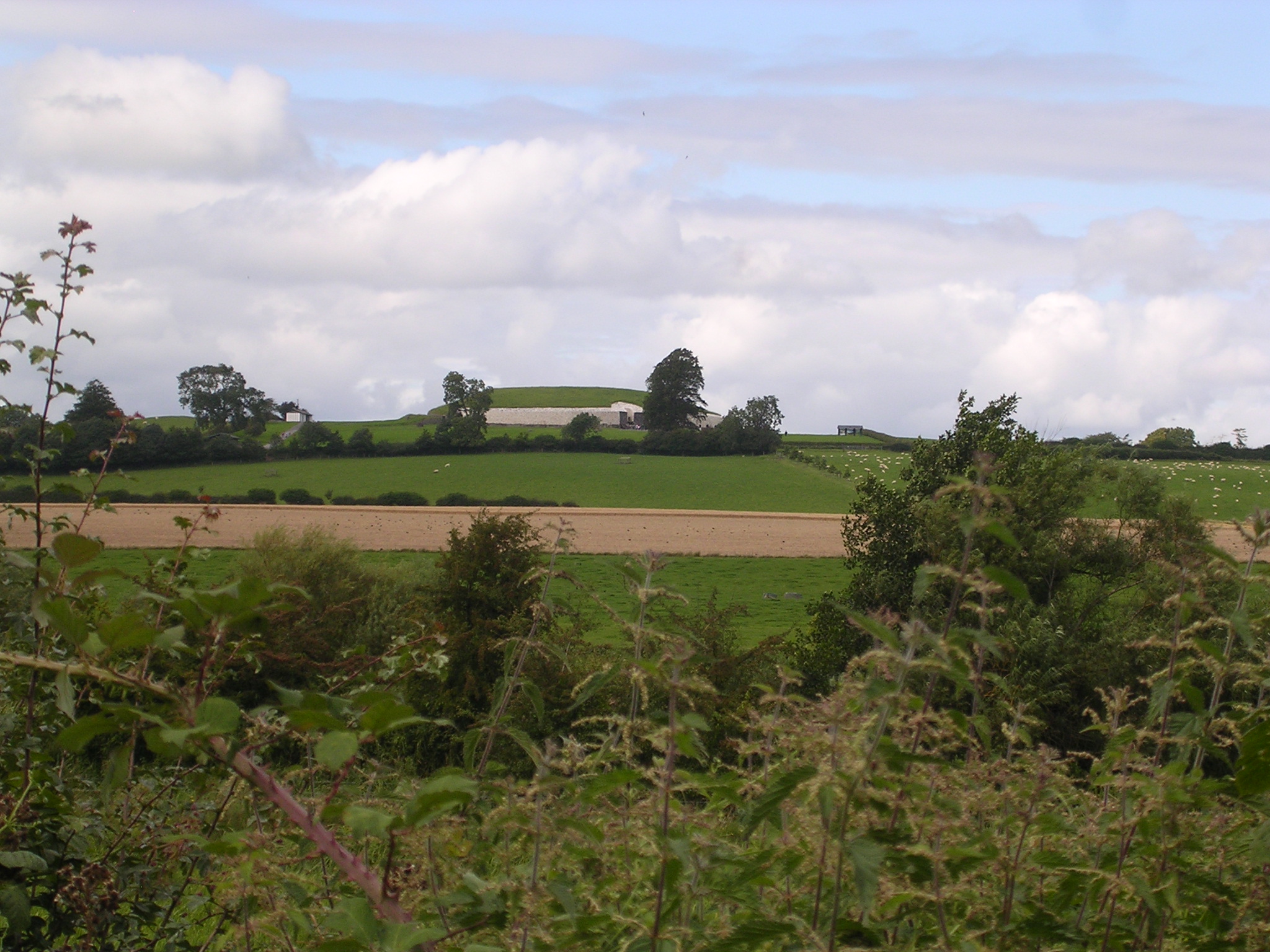
All this talk of tumuli and burial mounds, of course reminds me of Ireland. The most famous tumulus is at Newgrange, a megalithic tomb of the Neolithic age with a tumulus on top. Newgrange is surrounded by several smaller tombs at Knowth and Dowth in a complex called Bru na Boinne with 40 passage graves discovered so far. Tumuli are found all over Ireland, with other notable examples at Carrowkeel in Sligo.
Most tumuli and passage graves of various types in Ireland date to about 5000 years before the present, used until 2500 BCE. Newgrange is older than the pyramids, dated to circa 3100 BCE. Newgrange has three chambers at the end of the passage, about a third of the way into the mound. Each chamber contains a large basin stone, where the bones and ashes of the dead were laid during prehistoric times. Above the central chamber, there is a magnificent corbelled vault.
Newgrange has a 19 metre passage into a mound that is 85 metres at its widest. It had ceremonial importance as it aligns with the sunrise on the winter solstice. Large boulders were used in its construction, lining the passage into the tomb and forming the chambers. Outside several megaliths are decorated with designs. Newgrange was faced with white quartz, brought to the site from the Wicklow Mountains, two counties away. There is some disagreement as to whether the quartz was on the ground or used as facing. When reconstructing the sites, the stones were used as facing at Newgrange and left on the ground at Knowth. Newgrange looks more striking because of it.
Not all tumuli in Ireland are so large, but most are much older than the ones in Turkey. The oldest tumulus known in Turkey is Tumulus W at Gordion, dated to 850 BCE, which is over 2000 years younger than the ones around Newgrange. At Gordion, the largest tumulus is Tumulus MM (Midas Mound), rising to nearly 50 metres in height. It was excavated in 1957 and a wooden room was found in the centre with a royal occupant laid on rich cloths in an open wooden coffin. He was surrounded by rich grave gifts and furniture.
There are many other sites in Turkey, such as Bin Tepe in Manisa, which has over 100 tumuli including the giant Tomb of Alyattes 355 metres in diameter and 69 metres high. These tombs date to the Lydian period, the 7th and 6th centuries BCE. The most famous tumulus in Turkey is probably the one of the top of Mount Nemrut in Adiyaman. The 50-metre tall mound on the top of the mountain was built of loose rock for the Commagene King Antiochus in the 1st century BCE. It’s most famous for the east and west terraces on either side of the mound which are home to huge statues of Commagene gods and goddesses.
Raising a mound, barrow, kurgan or cairn over the burial place of an important person, and reusing the same mound for several people is a common tradition for many cultures and these sites are found on all continents.
Join the Conversation…